
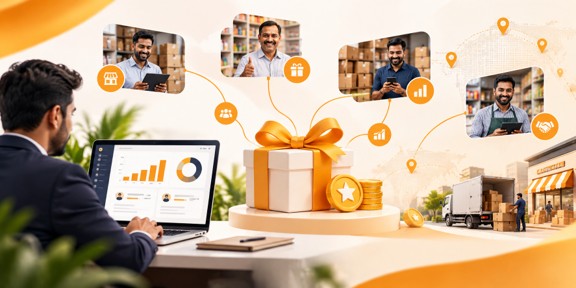
Why Channel Partner Engagement Is Different in FMCG
FMCG brands don't sell directly to consumers; they sell through a layered network of distributors, super-stockists, wholesalers and millions of retail outlets. Revenue depends entirely on how motivated, informed and loyal that network is.
Unlike a salaried workforce, channel partners have a choice every single day: stock your brand, or a competitor's. Shelf space, credit terms, and mindshare are won continuously, not once. That makes engagement, not just margins, the real currency of channel relationships.
The Core Challenges
Fragmentation at scale A national FMCG brand may work with thousands of distributors and lakhs of retail outlets spread across metros, tier 2 towns and rural markets. A one-size-fits-all engagement approach breaks down fast.
Low and uneven digital literacy Retail partners range from tech-savvy urban outlets to small shopkeepers who have never used a business app. Engagement tools have to work for both.
Trust and transparency gaps Delayed payouts, opaque scheme calculations, and slow dispute resolution erode trust faster than any competitor can.
Inconsistent communication Scheme updates, price changes and new launches often travel through field sales staff verbally, leading to delays, errors and inconsistent messaging across regions.
The Building Blocks of Channel Partner Engagement
1. Transparent Incentive Programmes Partners need to see, in real time, what they've earned and why. Slab-based schemes, volume incentives and seasonal promotions should be calculated automatically and communicated instantly, not reconciled manually at month-end. Automation also helps brands reduce incentive leakages caused by manual errors.
2. Recognition Beyond Money Top-performing distributors and retailers respond strongly to non-monetary recognition: leaderboards, badges, certificates, and preferential treatment on new launches. Recognition reinforces status within the partner's own local market.
3. Easy, Self-Service Redemption When a partner earns a reward, the redemption experience matters as much as the reward itself. A wide catalogue (vouchers, merchandise, travel, cash-outs) with instant, self-service redemption keeps the reward loop tight and satisfying.
4. Structured Communication Scheme launches, price revisions, and product training should reach every partner simultaneously, in their preferred language, through a channel they already check daily: WhatsApp, SMS, or a lightweight app.
5. Training and Product Knowledge Retailers who understand a product sell it more confidently. Bite-sized digital training modules, on new launches, positioning, or objection handling, build category expertise without pulling partners away from their counters.
6. Credit and Financing Support Working capital constraints are one of the biggest reasons small retailers under-stock. Integrated financing options, even modest ones, directly increase order sizes and partner loyalty.
What Good Engagement Looks Like in Practice
Measuring Engagement, Not Just Sales
Sales volume alone doesn't tell you whether a partner is engaged or just transacting out of habit. Better signals include:
Technology as the Enabler, Not the Strategy
Digital platforms don't replace the field relationship; they remove the friction around it. A distributor management or loyalty platform should let a partner check earnings, redeem rewards, and get scheme updates in the time it takes to check a WhatsApp message, freeing field teams to focus on relationship-building and problem-solving instead of paperwork and reconciliation.
For FMCG brands operating across India's diverse retail landscape, this means the platform has to work as well in a tier 3 town as it does in a metro: mobile-first, low-bandwidth-friendly, and available in the languages partners actually speak. Lifafa's PartnerPerx channel platform is built for exactly this.
Getting Started
Start with your highest-value tier of partners (the 20% who typically drive 80% of volume) and build a tight engagement loop for them first: transparent incentives, fast payouts, and real recognition. Prove the impact on retention and order size, then extend the model down through the broader network. For a step-by-step roadmap, read our guide to digitising channel management.
Channel partner engagement isn't a campaign. It's an ongoing relationship, and the brands that treat it that way consistently outperform those that only show up during scheme season.